FOREST BATHING
Paris-Fontainebleau-Versailles
Chantilly-Vaux le Vicomte
An immersive practice for recharging your batteries in nature
For individual, team and groups
Why participate in forest bathing?
Immerse yourself in the heart of nature for absolute well-being
Also known as Shinrin-Yoku, forest bathing originated in Japan in 1980. It’s an immersive practice that involves reconnecting with nature by soaking up the soothing atmosphere of forests.
Forest bathing is at once a collective and an individual well-being practice, that can be experienced in two-person to 25-person groups. For maximumbenefit I recommend a three or two-hour session, but a 45 minutes format is also available. Everyone can participate in a forest bathing, since no specific sport preparation is required. It is a highly accessible activity.
Far from the noise of the city, technology, and the hustle and bustle of life, nature restores us.
In response to the harmful effects of urban stress and overwork, the Japanese Ministry of Forestry encouraged this practice to improve the population’s well–being and reduce stress-related illnesses. Taking the time to observe, breathe, listen, and experience the forest allows us to relax and regain a fresh mind. Realizing that our senses are often closed forces us to recognize our shortcomings.
Now recognized for its benefits on physical and mental health, this practice has spread worldwide. For an even deeper immersion and a more advanced sensory experience, participate in a guided forest bath with Giulia Del Fabbro, your certified guide from excursus.net. I will help you slow down, refocus and get the most out of this calming practice which includes several workshops (fine tune your senses, adjust your breathing, be in the present moment, become aware of the flora and fauna, share your experience…).
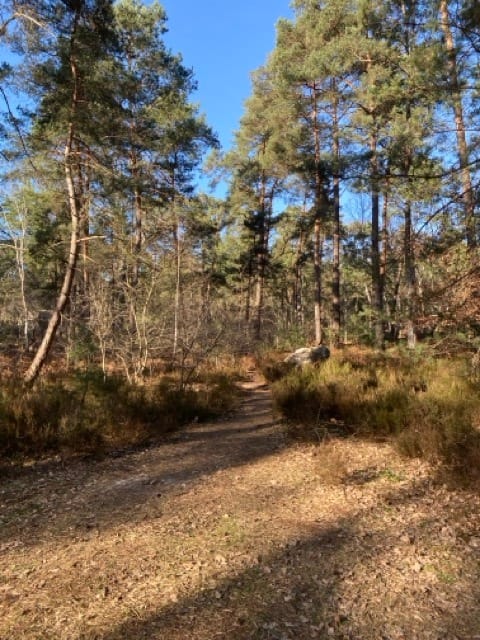
More than just a hike, I invite you to slow down amidst the truly majestic forests of Fontainebleau (and other surrounding woodlands), rich in phytoncides – essential oils released by trees that boost your immunity and reduce stress. Forget about performance, the stopwatch, or the destination. Here, only the journey matters.
Forest bathing can also be a teambuilding activity for teams or individuals.
Mobilize all your senses
The forest isn’t just something to be looked at; it’s something to be experienced with all the senses. I will guide you to “open” your sensory doors. We will learn to capture the nuances of light filtering through the canopy, to breathe in the phytoncides (natural essential oils) emitted by the trees or the scent of humus, to listen to the symphony of the wind and birds, or the silence between two rustles of leaves, and to touch the diversity of life, the rough texture of ancient bark beneath your fingertips. It’s an invitation to rediscover the world with a fresh mind, to recapture the wonder of a child.
Take time to breathe
The forest air is rich and invigorating. Through simple breathing exercises, we will deeply oxygenate our cells. Inhaling the pure air, charged with negative ions and terpenes, promotes relaxation and regulates the nervous system, releases accumulated stress, and calms our minds. Each breath becomes a source of energy, each exhalation a release. All of this greatly improves heart coherence.
Walk slowly
Forget about distance or performance goals.
We adopt an unusual, almost meditative pace. By slowing our steps, we allow our bodies to synchronize with the natural rhythm of the forest. It’s a walk without a destination, where each step is an anchor that grounds us to the earth and reconnects us to our inner selves.
Become aware of the present
This is the heart of our practice. By focusing on our immediate sensations, the incessant flow of thoughts calms. Worries of the past and plans for the future fade away, giving way to the present moment, in its fullness and simplicity. This can involve practicing meditation exercises, connecting with a tree, or simply sitting and appreciating the moment.
The forest, a source of well-being
Scientific research on shinrin-yoku has demonstrated numerous positive effects on the body and mind:
- Reduced stress and anxiety: Forest immersion lowers cortisol, the stress hormone, and provides a feeling of profound calm. A study published in Environmental Health and Preventive Medicine showed that participants practicing shinrin-yoku had significantly lower cortisol levels than those walking in an urban environment.
- Improved concentration and creativity: Disconnecting from screens and urban noise helps clear the mind and promote reflection. Research indicates that exposure to nature improves mood, attention span, and problem-solving skills. >Parks Canada+1ScienceDirect+1
- Strengthens the immune system: Phytoncides, natural chemicals released by trees, can strengthen the immune system by increasing the activity of natural killer (NK) cells. Parks Canada+1Connected by Nature+1
- Regulates blood pressure and heart rate: Walking in the forest can lower heart rate and blood pressure, and helps balance the nervous system, contributing to relaxation and overall well-being. Connected by Nature
- Deep connection with nature: Taking the time to observe and sense one’s surroundings develops a sense of gratitude and belonging to the natural world. A study published in Nature observed that in healthy adults, activity in the amygdala, a brain region associated with stress, decreased after an hour of walking in the forest, compared to walking in an urban environment. Wikipedia, the free encyclopedia Wikipédia, l’encyclopédie libre